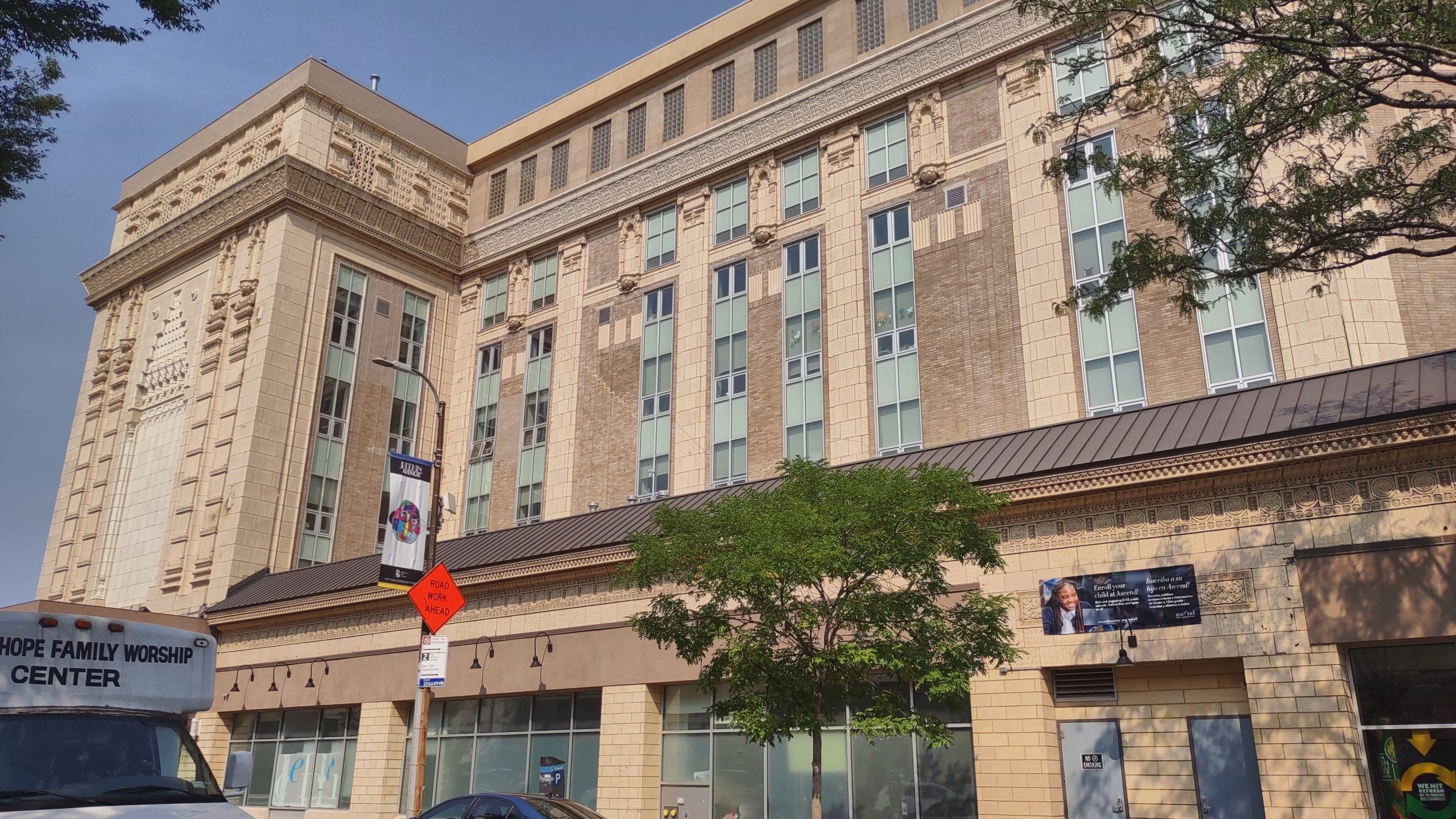
Hush Street is tracking what’s changing in Brownsville — a neighborhood whose development story runs almost entirely through public money and public land, not private towers.
Nearly everything rising here traces back to one document: the Brownsville Plan, a $1 billion, city-led commitment finalized in 2017 to build over 2,500 affordable homes on city-owned sites. It named three flagship sites that year. Eight years later, all three are real.
A fourth, newer story is unfolding alongside them: NYCHA using a brand-new federal tool for the first time anywhere, on the site of a long-abandoned police precinct.
Where a claim comes from a developer or agency’s own materials rather than independent reporting, we say so.
| Project | Location | Status |
|---|---|---|
| 1Glenmore Manor | 76 Christopher Avenue | Leasing / Lottery Open |
| 2Brownsville Arts Center & Apartments | 366 Rockaway Avenue | Under Construction |
| 3Livonia 4 / Gail P. Duke Senior Residence | 350 Livonia Avenue | Leasing / Lottery Open |
| 4Lebechi East | 1546 East New York Avenue | Under Construction |
| 5Brownsville Multi-Service Center | 444 Thomas S. Boyland Street | Near Complete |
A 2017 Promise, Delivered Site by Site
Five anchors: the two most-advanced flagship sites from the city’s 2017 Brownsville Plan, that plan’s largest single component, a separate NYCHA innovation happening a few blocks away, and a $128 million city-built community hub nearing completion.
1
Glenmore Manor
The Most Advanced of the 2017 Plan’s Three Sites
When the city unveiled the Brownsville Plan in 2018, it named this corner — then called Christopher-Glenmore — as one of three city-owned sites getting a competitively selected redevelopment. It has gotten there first: construction broke ground in July 2023, the building topped out in October 2024, and a housing lottery launched in January 2026.
The building’s 233 apartments are reserved for households earning between 30% and 80% of area median income — $22,492 to $160,720 for various household sizes. Fifty-nine units are set aside as permanent supportive housing for very low-income seniors, and 70 more for formerly homeless individuals and families.
A Credit Union, Not Just a Hub
The site’s other promised piece, the “B’Ville Hub,” is now taking shape too: roughly 20,000 square feet run by the Central Brooklyn Economic Development Corporation, anchored by a branch of Brooklyn Cooperative Federal Credit Union offering small-business loans and financial-literacy classes, plus a salon storefront. It’s a direct answer to the community-wealth-building goals the 2018 plan set out — not a generic ground-floor retail space.
Sources: NYC HPD (2018 plan); New York YIMBY; Brooklyn Paper; Local Content (B’Ville Hub)
2
Brownsville Arts Center & Apartments
The 2018 Plan’s Cultural Anchor
This is the second of the Brownsville Plan’s three original 2018 sites, then called Rockaway-Chester and always envisioned around arts and culture. That vision survived nearly intact: NYC’s Department of Housing Preservation and Development announced City Council approval in 2024, and Mayor Adams, Gilbane, Blue Sea, and Artspace — a national nonprofit developer of artist housing — broke ground in September 2025.
The 283 apartments, ranging from studios to three-bedrooms, will house households earning between 30% and 70% of area median income, with dedicated units for formerly homeless individuals. Above and alongside them, Artspace will operate a 28,000-square-foot arts center with a 3,440-square-foot black-box performance and rehearsal space, built in partnership with local cultural groups including BRIC and Purelements — the same dance company named in the original 2018 announcement.
The Corridor Is Filling In Around It
A block away, permits filed in August 2026 describe a nine-story, 99-unit building at 69 Chester Street — early evidence that Rockaway Avenue and Chester Street are attracting more than just this one flagship project.
Sources: Gilbane Development; Artspace; Brownstoner; 6sqft; New York YIMBY (69 Chester St.)
3
Livonia 4 / Gail P. Duke Senior Residence
The Third Original Site, in Four Pieces
The third of the 2018 plan’s original sites was simply called “Livonia Avenue.” It has since taken shape as Livonia 4 — four separate parcels along Livonia Avenue delivering more than 420 units total, aimed at extremely low-income households, formerly homeless households, and low-income seniors. One site is planned around a new supermarket, café, and rooftop greenhouse; the others add community gardens, social services, and a youth and family recreation facility.
Gail P. Duke Senior Residence, at 350 Livonia Avenue, is the piece furthest along. Designed to Passive House standards with solar panels and heat-pump water heaters, its 142 units include 24 studios and 23 one-bedrooms in the current lottery phase. NYCHA project-based vouchers mean rent is generally 30% of a tenant’s adjusted income — for a household with no income, that’s effectively $0 a month. A 10,000-square-foot Older Adult Center, run by Catholic Charities Neighborhood Services, rounds out the building.
Sources: New York YIMBY (Livonia 4); Hoodline; Brownstoner
4
Lebechi East
NYCHA’s First Use of a New Federal Tool
Unlike the three sites above, Lebechi East isn’t part of the original Brownsville Plan — it’s a separate, newer NYCHA initiative on the site of a long-vacant police stationhouse. NYCHA transferred 38,000 square feet of unused development rights and 6,200 square feet of underutilized land from the adjacent Howard Houses campus to enable it — described by the state as the first time NYCHA has used HUD’s “Transfer of Assistance” tool anywhere.
The resulting 95-unit building includes 57 supportive apartments for people who have experienced homelessness, 11 mobility-accessible units, and 5 for sensory disabilities — with 8 units set aside specifically for existing Howard Houses residents. On the ground floor, Family Services Network of New York will run a health clinic offering primary care and job-training services. Financing includes roughly $24 million in low-income housing tax credit equity, an $18 million HPD supportive-housing loan, and $522,000 in clean-energy funding.
A Wider, Aging NYCHA Footprint Nearby
Lebechi East sits within a much larger NYCHA presence — Brownsville Houses (1948), Van Dyke Houses (1964), and Tilden Houses (1961) together house thousands of residents in aging buildings. NYCHA’s own 2023 physical needs assessment put the repair backlog at Van Dyke Houses alone above $200 million for roofs, boilers, elevators, and mold remediation — a reminder that new infill construction and unmet capital repairs are running in parallel here, not one instead of the other.
Sources: NY Homes and Community Renewal; Gothamist; Van Dyke Houses
5
Brownsville Multi-Service Center
A City-Owned Site, Rebuilt Faster Than Usual
Alongside the Brownsville Plan’s three housing sites and Lebechi East, the city has been quietly rebuilding its own civic infrastructure here too. DDC demolished the prior community center on this site starting in 2023 and replaced it with a new, ground-up four-story building combining a roughly 30,000-square-foot multi-service center with an 18,000-square-foot community center — multiple conference rooms, a teaching kitchen, a 1,600-square-foot community garden, green roofs on floors two through four, solar panels, and public artwork by local artist Jazmine Haynes. The building becomes the new home of Brooklyn Community Board 16.
City officials have pointed to this project’s design-build delivery method — the same contractor handles both design and construction, rather than the city bidding them separately — as a template for cutting years off typical public-project timelines. DDC reported the topped-off structure came in roughly $10 million under budget.
Sources: NYC Department of Design and Construction; Brownstoner; Brooklyn Paper
What We’re Watching Next
The clearest open question is whether the Brownsville Arts Center’s December 2027 target and Livonia 4’s remaining three sites stay on schedule — Glenmore Manor’s own path from 2018 announcement to 2026 lottery took roughly eight years, and neither of the other two is fully finished yet. It’s also worth revisiting whether NYCHA’s Transfer of Assistance tool at Lebechi East gets used again elsewhere in the city, or stays a one-off.
A smaller private filing is also worth a future look: renderings were revealed in March 2026 for a six-story residential building at 373 Herzl Street from Bayview Developers, on a lot near the Brownsville Arts Center site — unit count and construction timeline are both still unannounced, too early for a full section of its own.
Capital & Transactions
Money Moving in Brownsville
A curated look at recent property sales and financing that help explain who’s buying, building, and lending in Brownsville right now. Drawn from New York City’s public ACRIS property records, not a complete log of every filing — we include only transactions that say something real about the neighborhood’s direction, and leave out routine paperwork, internal transfers, and deals we can’t explain responsibly.
Plaza Residences (201 Hegeman Ave. / 240 Lott Ave.)Jul. 2026
A Low-Income Housing Tax Credit-financed affordable housing project, with NYC Housing Preservation and Development involvement — not one of this Tracker’s existing projects, a genuine addition to the neighborhood’s affordable-housing pipeline.
73 Junius Street (Junius Street Family Residence)Jul. 2026
A major refinancing on one of Brownsville’s largest supportive/shelter housing assets — a 204-unit family residence operated with Women In Need — not currently in this Tracker.
Source: New York City’s public ACRIS property records. This module is reviewed and curated by Hush Street editors, not an automated feed, and will be updated as new, meaningful filings are confirmed.
Brownsville borders Crown Heights to the northwest and East New York to the east; neither of those areas’ projects were absorbed into this Tracker.
By Hush Street Editorial Updated Built from city filings and published reporting. About Hush Street


