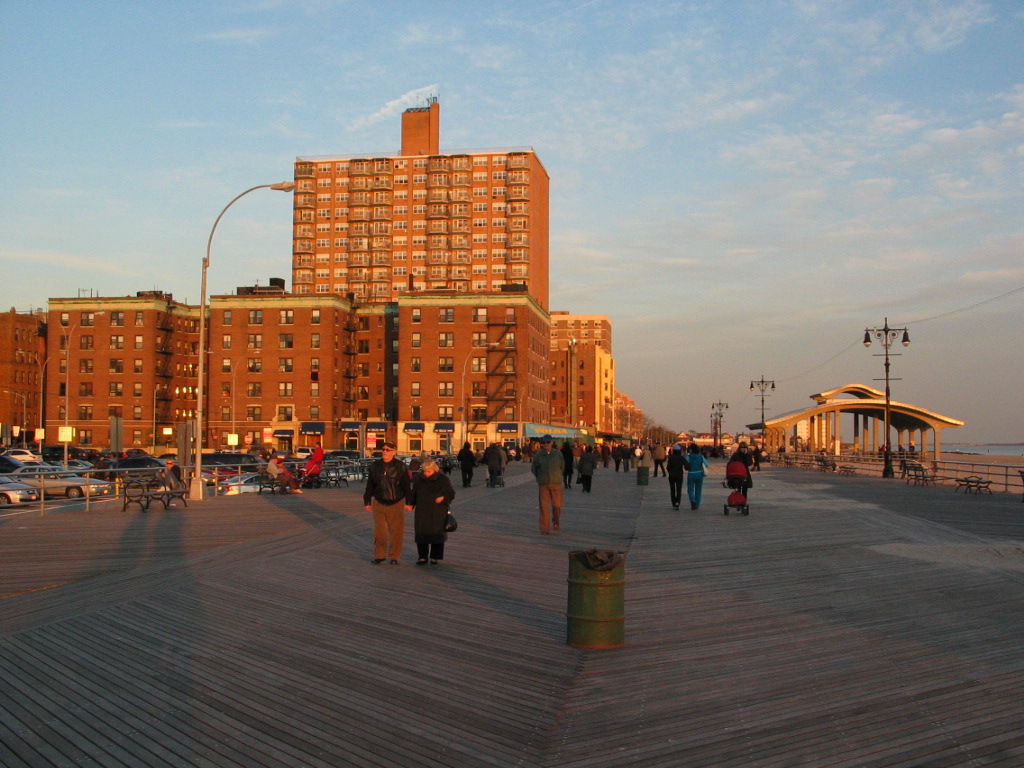
Hush Street is tracking what’s changing in Brighton Beach — and the honest answer is: not what you’d expect from its neighbor.
Coney Island, next door, has spent the last decade drawing big-name developers, public rezonings, and billion-dollar headlines. Brighton Beach, nicknamed “Little Odessa” since large-scale Russian and Ukrainian immigration reshaped the neighborhood starting in the 1970s, has absorbed just as much real investment — but almost none of it comes from outsiders, and almost none of it makes industry news.
That gap between real dollars and public visibility is the actual story here, and it’s worth naming up front rather than treating it as a footnote: this Tracker’s fourth section isn’t a single building at all, but the documented pattern of who builds in Brighton Beach and why outside developers so rarely try. Understanding that pattern is what makes sense of the other three projects — a public boardwalk in genuine crisis, and two small private buildings that are unusually hard to get a straight status update on.
The one project that does touch both neighborhoods at once is literal: the boardwalk beneath everyone’s feet, opened in 1923 and now falling apart faster than the city can fix it.
Where a claim comes from a developer or agency’s own materials rather than independent reporting, we say so.
| Project | Location | Status |
|---|---|---|
| 1The Riegelmann Boardwalk | Brighton Beach shoreline | RFQ Released, Team TBD |
| 22960 Brighton 4th Street | 2960 Brighton 4th Street | Stalled |
| 323 Brighton 11th Street | 23 Brighton 11th Street | Permits Filed |
| 4The Insider Market | Neighborhood-wide | Ongoing |
A Neighborhood That Builds Differently
Four anchors: a shared, deteriorating boardwalk awaiting a $1 billion fix, a six-years-stalled condo tower, a community/health facility working through permitting, and the closed, relationship-driven development culture that shapes almost everything else here.
1
The Riegelmann Boardwalk
A Shared Problem, Not a Brighton Beach-Only One
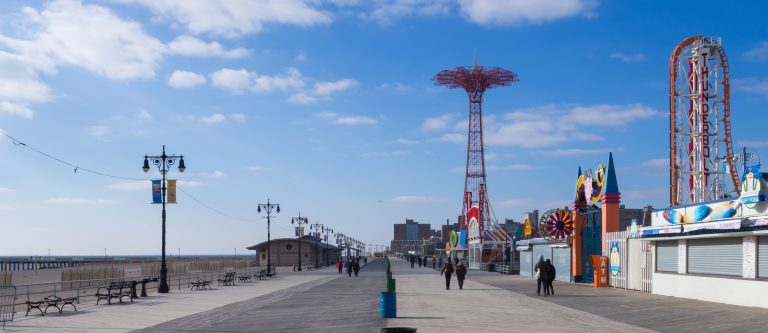
In December 2025, the Mayor’s Office announced more than $1 billion to rebuild the Coney Island shoreline, including full reconstruction of the entire 2.7-mile Riegelmann Boardwalk — the same boardwalk that runs through Brighton Beach on its way east. That larger investment also funds a separate rezoning push for “Coney Island West,” roughly 1,500 mixed-income apartments; that piece belongs to Coney Island’s own development story, not Brighton Beach’s, and Hush Street won’t duplicate it here.
The boardwalk reconstruction itself is real and shared: new structural piles and utilities, elevated sections in a “tiered” design with a lower landward level and upper waterside level, and a proposed buried seawall covered in sand dunes, set back to preserve ocean views. Community members have specifically asked for beach-grass dune stabilization “like the Rockaways has”. Parks officials say raising the boardwalk now won’t conflict with any future Army Corps of Engineers storm-barrier plan. That procurement pipeline has now produced its first concrete step: on October 1, 2026, NYCEDC and NYC Parks jointly released a Request for Qualifications for a single progressive design-build team to handle both design and construction across the boardwalk’s full 2.4-mile reconstruction zone, from West 37th Street to Brighton 15th Street. Responses are due November 4, 2026, with an optional information session October 9; the city expects to select a qualified team by spring 2027, with a Request for Proposals going to the shortlist this winter. A separate, $42 million renovation of the Abe Stark Sports Center — new ice-rink upgrades plus a new boardwalk-facing entrance — is funded independently and proceeding on its own schedule, not tied to the main RFQ timeline.
That’s a strikingly long horizon for a structure that’s over a century old. The boardwalk opened in 1923, running roughly 2.7 miles between West 37th Street and Brighton 15th Street, and has needed periodic, patchwork rebuilding ever since — this latest plan is best understood as the first attempt at a genuinely comprehensive, storm-hardened rebuild rather than another round of the same board-by-board maintenance that’s kept it standing for a hundred years.
In the Meantime, It’s Falling Apart
That six-year horizon is cold comfort for Brighton Beach residents dealing with the boardwalk as it is today. Broken planks, raised boards, and gaping holes have turned daily walks into an obstacle course — residents told local reporters they’ve resorted to setting trash cans over the worst gaps to warn joggers and seniors. One jogger told a reporter he’d simply tripped “a few times” and learned to watch his footing; a longtime neighbor put it more bluntly: “It’s horrible. What can I do, what can I say? Where do you go?” Brooklyn Parks Commissioner Marty Maher said four repair crews are working section by section from April through November 2026, prioritizing the worst stretches first while keeping the boardwalk open — a genuinely stopgap measure, by the city’s own account, meant to hold the structure together until the larger rebuild can start.
Sources: 6sqft; Hoodline; Brooklyn Paper; Wikipedia; NYCEDC (upcoming procurement opportunities)
2
2960 Brighton 4th Street
Six Years Past Its Original Completion Date
This is one of the largest individual buildings ever proposed in Brighton Beach, and one of its clearest cautionary tales. Permits were first filed in September 2015 for a 29,500-square-foot building with 22 condos averaging roughly 1,030 square feet each, designed by Dome Architecture for developer Maya Zubok’s 4th Brighton Realty LLC.
The original target completion date was December 2020. New York YIMBY’s most recent check-in, in November 2024, found work still stalled — no revised construction timeline, renderings, or amenity list had been disclosed. No public reporting has surfaced explaining the delay. NYC Department of Buildings records confirm the site remains an active, maintained construction site rather than an abandoned one: the sidewalk shed permit has been renewed repeatedly, most recently in June 2026, nearly two years after that YIMBY check-in.
That silence is itself the story worth noting. In a neighborhood with institutional developers, a six-year stall on a 22-unit building would ordinarily draw a lender’s public dispute, a lawsuit, or at least a trade-press quote from someone involved. Here, none of that has surfaced — not because nothing happened, but because a small, privately financed local project like this one has no obligation, and apparently no inclination, to explain itself to anyone outside its own circle. That’s exactly the pattern this Tracker’s fourth section documents in more depth below.
Sources: New York YIMBY (2015 filing); New York YIMBY (2024 status); NYC DOB NOW permit records (job B00131843-I1)
3
23 Brighton 11th Street
Academic Space Below, Health Care Above
Filed in 2023, this project would bring an unusual vertical split to a single building: roughly 24,800 square feet of community-facility space, with the lower floors set aside for academic use and floors six through eight plus the rooftop dedicated to ambulatory health facilities. Developer Natalya Zagranichny, per city property records, is also behind several other condo and office projects in the immediate area.
Hush Street found no public reporting confirming current construction progress since the 2023 filing — a genuine open question rather than a status we’re comfortable asserting either way, and a useful example of how much harder these projects are to track here than in neighborhoods with more institutional developers issuing their own updates. It’s also directly relevant to who’s actually building here: Zagranichny is one of the same small group of local developers documented in the “insider market” pattern this Tracker covers next, and her multiple other projects in the immediate area, per city property records, are a small-scale illustration of exactly that pattern in action.
Sources: New York YIMBY
4
The Insider Market
$720 Million, Almost Entirely Under the Radar
A 2026 Bisnow investigation put real numbers on what every other source here only implies: Brighton Beach has seen roughly $720 million in investment sales over the past decade — matching Coney Island’s total — and 730,000 square feet of new building applications filed over the same period. Retail rents along Brighton Beach Avenue reportedly hit $80 to $100 per square foot, higher than Greenpoint’s Manhattan Avenue or the DUMBO waterfront. None of that shows up as major-developer press releases, because almost none of it involves major developers.
Instead, per Bisnow’s reporting, the same small group of local, Russian- and Ukrainian-speaking developers — among them Yelena Maksumov (a project at 1002 Banner Avenue, plus a larger mixed-use project in Sheepshead Bay), Lev Kheyfets (13 units at 2948 Brighton 4th Street; 15 units at 537 Brooklyn Avenue), and 23 Brighton 11th Street’s own Natalya Zagranichny — repeatedly assemble sites, secure financing, and build, largely invisible to institutional investors and citywide coverage. As one real estate professional told Bisnow, describing how thoroughly the same names recur: “It’s the same players over and over again. They all originate from here, they understand the product, they understand the people.”
Why Outsiders Stay Out
Brighton Beach’s own zoning caps building scale well below Coney Island’s more permissive districts — developer Eli Weiss told Bisnow “the zoning just doesn’t allow for the scale that would justify us looking there.” That’s a genuine, structural reason a Coney-Island-scale institutional project simply couldn’t happen on most Brighton Beach parcels even if a big developer wanted to try.
Beyond zoning, brokers describe language barriers, informally negotiated (and sometimes steep) neighbor access fees needed to assemble adjacent lots, and a community that, as one local professor put it, prefers developers who “give them a sense that it’s happening to make our neighborhood better” over outside institutional credentials. The clearest distillation of the dynamic, per Bisnow’s own reporting, is almost anthropological: “In a neighborhood heavily influenced by the Soviet Union, trust is earned with a jar of homemade pickles and a handle of Russian Standard vodka. Not a check from a fancy-sounding name.” It’s a genuinely different development culture from almost every other Brooklyn neighborhood Hush Street tracks — not a gap in the market, but a market that runs on different rules.
The two outside developers who have succeeded here prove the point rather than undercutting it. Muss Development’s Oceana, a 16-building boardwalk complex built out in the mid-2000s, and Rybak Development’s 20-story Sea Breeze Tower are both large, name-brand projects near Brighton Beach — but both required years of relationship-building in the neighborhood first, and Sea Breeze Tower’s own address and marketing sit close enough to the Coney Island line that its own building listings file it under that neighborhood instead. Even the exceptions to the insider-market pattern aren’t clean exceptions.
What We’re Watching Next
The clearest open question is whether 2960 Brighton 4th Street ever resumes — six years past its original completion date with no public explanation is long even by this neighborhood’s standards. It’s also worth watching whether the Riegelmann Boardwalk’s design-build team selection actually lands by spring 2027 as the city now projects, given the plan is still years from breaking ground as of this Tracker, and whether 23 Brighton 11th Street’s permitted community-facility building ever breaks ground at all.
Also worth watching: a five-lot, 11,400-square-foot assemblage at 249 Brighton Beach Avenue (up to 54,720 square feet buildable) is on the market as of this update — no application has been filed yet, so it’s a lead, not a project, but it’s the kind of site where this Tracker’s insider-market pattern would predict a local, not institutional, buyer.
More broadly, it’s worth watching whether Brighton Beach’s insider market itself changes shape over the next several years. Nothing in the record suggests it’s opening up to outside capital — if anything, the zoning and cultural barriers Bisnow documents look durable — but the neighborhood’s own $720 million decade of investment sales shows real money is already moving. Whether that money stays concentrated among the same handful of local names, or gradually institutionalizes the way Coney Island’s did a decade ago, is the more interesting long-run question behind every individual permit filing in this Tracker.
Brighton Beach borders Coney Island to the west and Sheepshead Bay/Manhattan Beach to the east; this Tracker deliberately did not absorb Coney Island’s own, much larger and more heavily covered development story (including Sea Breeze Tower and the “Coney Island West” rezoning) simply to make this one longer.
By Hush Street Editorial Updated Built from city filings and published reporting. About Hush Street