Hush Street is tracking what’s changing in Bushwick — a neighborhood whose defining development fight was never actually resolved, and whose current growth shows it.
Starting around 2014, City Council Members Antonio Reynoso and Rafael Espinal joined with Brooklyn Community Board 4 and a wide range of local stakeholders to build the Bushwick Community Plan — years of meetings meant to produce a comprehensive rezoning blueprint the neighborhood itself would author, trading some new density for real affordability guarantees and protections against displacement. When the plan was unveiled in 2018, the city ultimately rejected it in favor of its own, different rezoning vision. No citywide replacement process ever followed. What’s actually gotten built here since has come piecemeal instead — one contested spot rezoning at a time, plus NYCHA’s own separate capital-investment track, plus a steady wave of small private permits that add up to real change without any single plan behind them.
That’s a genuinely different story from the one Bushwick is usually told through: the 2010s wave of warehouse-to-loft conversions — the Rheingold Brewery megaproject, the Glassworks glass-factory rental — that made Bushwick a magazine-cover gentrification story nationally. Those projects are essentially finished now, their towers leased and their factories converted years ago. What’s happening in 2026 is smaller in scale, more openly contested at the community-board and City Council level, and more often driven by public institutions than by the private capital that defined the prior decade.
Where a claim comes from a developer or agency’s own materials rather than independent reporting, we say so.
| Project | Location | Status |
|---|---|---|
| 11601 DeKalb Avenue | 1601 DeKalb Avenue | Topped Out / Lottery Open |
| 2NYCHA Hope Gardens | Wyckoff Avenue & Linden Street | New State Funding |
| 321 Charles Place | 21 Charles Place | Construction Permit Issued |
| 4Corridor Infill | Neighborhood-wide | Permits Filed |
| 5Hylan Houses Modernization | 131 Moore Street | Design-Build Team Selected |
A Plan That Failed, and the Piecemeal Growth That Followed
Five anchors: a completed but genuinely contested affordable-housing rezoning, NYCHA’s own parallel investment track (now with a second, separate NYCHA modernization underway a few blocks away), the largest single permit currently filed, and a wave of smaller buildings filling in behind them.
1
1601 DeKalb Avenue
The Fight Behind a “100% Affordable” Building
This project’s own path to construction is a case study in what Bushwick’s development politics actually look like now that the neighborhood’s comprehensive rezoning plan is dead. Camber Property Group and RiseBoro Community Partnership pursued a site-specific rezoning here — not the citywide Bushwick Community Plan, which the city had already rejected — and it became genuinely contested along the way. Brooklyn Community Board 4 voted overwhelmingly against it in April, and a City Council land-use subcommittee ultimately forced three changes before approval: a deeper affordability tier under Mandatory Inclusionary Housing, a density cut from R7A to R6A (lowering the floor-area ratio from 4.0 to 3.0), and the explicit exclusion of existing Wyckoff Avenue businesses from the rezoned area. Subcommittee chair Francisco Moya said those businesses “provide jobs, serve the community, and are consistent with the Bushwick Community Plan” — an explicit, on-the-record instance of a rejected 2018 plan still functioning as the yardstick city officials use to judge individual projects years later.
The rezoning was ultimately completed in 2018, and the site sat vacant for years afterward — Camber and RiseBoro closed their $75 million financing only in December 2023, breaking ground in April 2024.
What’s Actually There Now
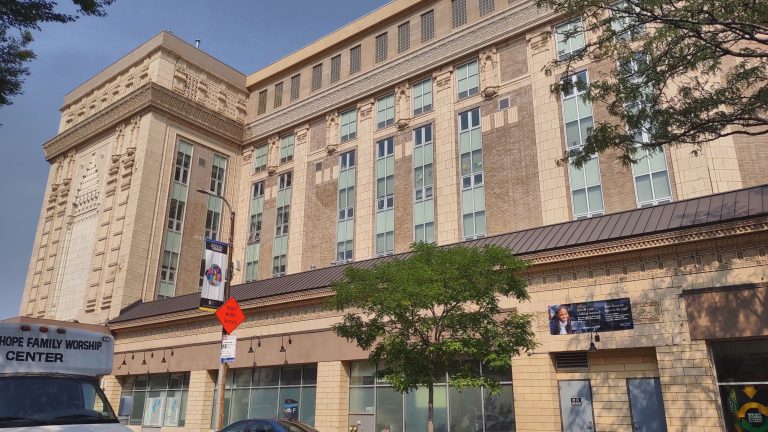
The finished building delivers 127 apartments, studios through three-bedrooms, entirely affordable to households earning 40% to 120% of area median income — a real income range from roughly $30,823 to $241,080 depending on household size and unit. Forty-five units are set aside specifically for supportive housing with on-site services for young families. It topped out in December 2024, and a housing lottery opened in September 2025 with studios starting around $788 a month — the certificate of occupancy was targeted for January 2026, meaning the building is very likely occupied by the time of this Tracker.
Sources: Brownstoner; The Real Deal; Brooklyn Eagle; New York YIMBY; RiseBoro Community Partnership
2
NYCHA Hope Gardens
A Separate Track From Everything Else in This Tracker
Public housing in Bushwick runs on its own investment cycle, entirely separate from the ULURP/rezoning process shaping 1601 DeKalb or the neighborhood’s private permits. Before its renovation, Hope Gardens had fallen into the kind of disrepair that’s become a familiar NYCHA story citywide: City Limits reported persistent rodent infestations severe enough to shut down a senior center for three months, along with recurring heating and hot-water failures and a maintenance backlog residents said had gone unaddressed for years. One tenant described hearing rats “in the ceiling” of the senior center itself.
That backdrop is what makes the fix notable. Hope Gardens — four buildings housing more than 700 residents — went through NYCHA’s Permanent Affordability Commitment Together (PACT) program: a $391 million renovation covering 1,315 units across the wider Hope Gardens/Palmetto Gardens/Bushwick II campus, converting federal subsidy from Section 9 to Section 8 so NYCHA could borrow against a 20-year contract to fund kitchen and bathroom renovations (roughly $62,000 per unit), new heating and plumbing systems (~$39 million), exterior work including roofing and masonry (~$29 million), and site/landscaping work (~$13 million) — against a total identified capital need of $232.6 million. Residents kept rent caps at 30% of income and succession rights; Pennrose LLC took over day-to-day management, with social-services partners including RiseBoro Community Partnership — the same nonprofit co-developing 1601 DeKalb Avenue a short walk away. Not every resident welcomed the change: some feared “right-sizing” into smaller units, and some social-service workers worried about losing their jobs under new management. That renovation is now complete.
What’s new is layered on top of it: a $3 million New York State capital grant, announced in June 2026, specifically for the Hope Gardens Youth Center — basketball-court renovations, indoor space improvements, and HVAC upgrades for a facility that already runs year-round basketball, soccer, and multicultural programming for the complex’s young residents. Assemblymember Dilan said the goal is a “state-of-art center with updated facilities that will be a magnet for our youth.”
Why This Belongs Next to a Private Rezoning Fight
It would be easy to treat NYCHA investment as a separate story from Bushwick’s private development fights, but the two are more connected than they look: both are responses to a neighborhood the city has, at different points, treated as underinvested — one through affordable-housing rezonings that require years of contested public review, the other through a public-housing authority converting its own financing structure to unlock capital it couldn’t otherwise borrow. Neither mechanism is the sweeping, comprehensive plan Bushwick’s own community board once proposed.
Sources: City Limits; NY State Assembly (Hope Gardens Youth Center); NYCHA Now
3
21 Charles Place
The Neighborhood’s Biggest Current Filing
Near the Myrtle Avenue subway station (J/M/Z), this is the largest individual building currently filed anywhere in Bushwick outside the already-under-construction 1601 DeKalb Avenue — 99 residences in an 11-story building, filed by Lefko Capital Group through architect Boaz Golani. No demolition permit, renderings, or affordability breakdown had been disclosed as of this Tracker; some secondary coverage of the broader Myrtle Avenue corridor cited a larger, roughly 144-unit figure for a project in the same stretch, which Hush Street has not been able to independently confirm refers to this specific filing rather than a separate, nearby one — recorded as an open question rather than resolved either way.
Sources: New York YIMBY (permit filing); Marketproof; NYC DOB NOW permit records (job B01320823-I1)
4
Corridor Infill
Smaller Filings, Real Cumulative Change
Beyond the three anchors above, a genuine wave of smaller permits is filling in Bushwick’s side streets. At 11 Cornelia Street, between Broadway and Bushwick Avenue, permits describe a nine-story, 56-unit building. At 132-136 Melrose Street, Melrose Towers Corp. is seeking a zoning map amendment (M1-1 to R6A/M1-2A) for a six-story, 18-unit mixed-use building — a small-scale version of the same industrial-to-residential conversion that defined the Rheingold and Glassworks projects a decade earlier, just at a fraction of the scale. At 169 Knickerbocker Avenue, permits would expand an existing three-story structure into four stories with eight units, and at 316 Stockholm Street, a four-story building is rising with eight rental units.
None of these individually rises to the scale of 1601 DeKalb or 21 Charles Place, and none is being given its own full section here for that reason. Together, though, they’re real evidence that Bushwick’s growth hasn’t stopped just because its comprehensive rezoning plan did — it has simply moved down to a scale small enough that no single approval process, and no single Tracker section, can capture it in one place.
5
Hylan Houses Modernization

A Second, Separate NYCHA Track — Not Hope Gardens, and Not Brownsville’s Hylan
This is a different building from Hope Gardens above, and a different modernization mechanism too: where Hope Gardens converted under NYCHA’s older PACT/RAD program (Section 9 to Section 8, private management partner), Hylan Houses is converting under the newer NYC Public Housing Preservation Trust, a public entity created specifically to unlock federal financing while keeping developments 100% publicly owned. It’s also worth disambiguating from a similarly-named, unrelated development: this is Bushwick’s own Hylan Houses (131 Moore Street, part of the connected Bushwick-Hylan Houses campus), not Brownsville’s separate John F. Hylan Houses.
Hylan Houses became the fourth NYCHA development citywide to vote for the Trust, in April 2025. The Trust’s board approved Technico Construction Services and STV — one of North America’s largest infrastructure-focused engineering firms — as its “progressive design-build” partner in June 2026, the first time that specific delivery method has been used at any NYCHA property. Residents keep their rights and permanently affordable rent under the Trust’s federally funded Project-Based Section 8 conversion; the modernization itself covers all 209 apartments in the single tower, with design, financing, and construction targeted for completion by 2029.
Sources: New York YIMBY; NYCHA; The NYCHA Journal; NYC Public Housing Preservation Trust
What We’re Watching Next
The clearest open question is whether 1601 DeKalb Avenue’s contested rezoning process becomes a template other Bushwick projects have to follow, or stays a one-off shaped by this particular site’s own politics. It’s also worth revisiting whether NYCHA directs further capital funding to Hope Gardens beyond this year’s youth-center grant, and whether Hylan Houses’ progressive design-build approach gets reused at another NYCHA campus the way the Trust itself hopes.
A vacant, midblock lot at 76 Bushwick Place (2,576 sq ft, R6/C1-3) is on the market as of this update — no application filed yet, worth a future look if it sells and files.
Bushwick borders Williamsburg and East Williamsburg to the northwest, Bedford-Stuyvesant to the southwest, and Ridgewood, Queens to the east; none of those areas’ own projects were absorbed into this Tracker.
Worth noting for context: the projects that made Bushwick’s adaptive-reuse reputation in the first place are both essentially finished now. The Rheingold Brewery site — rezoned from industrial use back in 2013 — was ultimately split among three separate developments: 10 Montieth Street (“The Rheingold,” Rabsky Development with ODA Architecture, roughly 500 rental units around a sloped green roof and urban farm), 115 Stanwix Street (sold by Rabsky to JCS Realty, 130 units, now leasing as The Stanwix), and 123 Melrose Street (All Year Management, roughly 900 units in a 1-million-square-foot complex with public park space) — together bringing more than 1,500 apartments to a former industrial block, with some of that project’s own affordable-housing commitments later reduced from what was originally negotiated. A few miles away, Glassworks Bushwick converted the historic Dannenhoffer Opalescent Glass factory at 336 Himrod Street — built by a German immigrant glassmaker around 1888 — into a 63-unit rental with its Victorian brick and ceiling beams preserved inside new construction. Both are now fully leased, complete developments rather than current construction stories, which is exactly why neither gets its own section here.
Capital & Transactions
Money Moving in Bushwick
A curated look at recent property sales and financing that help explain who’s buying, building, and lending in Bushwick right now. Drawn from New York City’s public ACRIS property records, not a complete log of every filing — we include only transactions that say something real about the neighborhood’s direction, and leave out routine paperwork, internal transfers, and deals we can’t explain responsibly.
21 Charles PlaceSep. 2026
Already a full section of this Tracker (Section 3, above): Lefko Capital Group’s 99-unit, 11-story building, now with an active construction permit (issued August 2026). This $5 million financing, recorded September 2026, is the first confirmed capital detail for it beyond the permit filing itself.
169 Knickerbocker AvenueJul. 2026
One of the four small filings already covered in this Tracker’s bundled Corridor Infill section, above — an expansion of this three-story structure into four stories with eight units. New York YIMBY independently confirms the February 2025 permit filing; this $5.4 million financing, recorded mid-2026, is the first confirmed capital detail for it.
Source: New York City’s public ACRIS property records. This module is reviewed and curated by Hush Street editors, not an automated feed, and will be updated as new, meaningful filings are confirmed.
By Hush Street Editorial Updated Built from city filings and published reporting. About Hush Street